

What April Fools' Actually Reveals About a Brand
Most brands treat April Fools' Day like a free pass: post something weird, get a few laughs, and move on. The ones that actually won this year did something different. They started with what they knew about their audience, not with a joke they wanted to tell.
At SOA, we track how brands show up at cultural moments, because how a brand behaves on April 1st usually reveals something true about how it thinks the other 364 days. 2026 made that clearer than ever.
The joke has to come from inside the brand
The campaigns that worked best in both years share one quality: the joke was a believable next step, not a random leap. The humor came from exaggerating something the brand already owned, not from borrowing a cultural trend that had nothing to do with them.
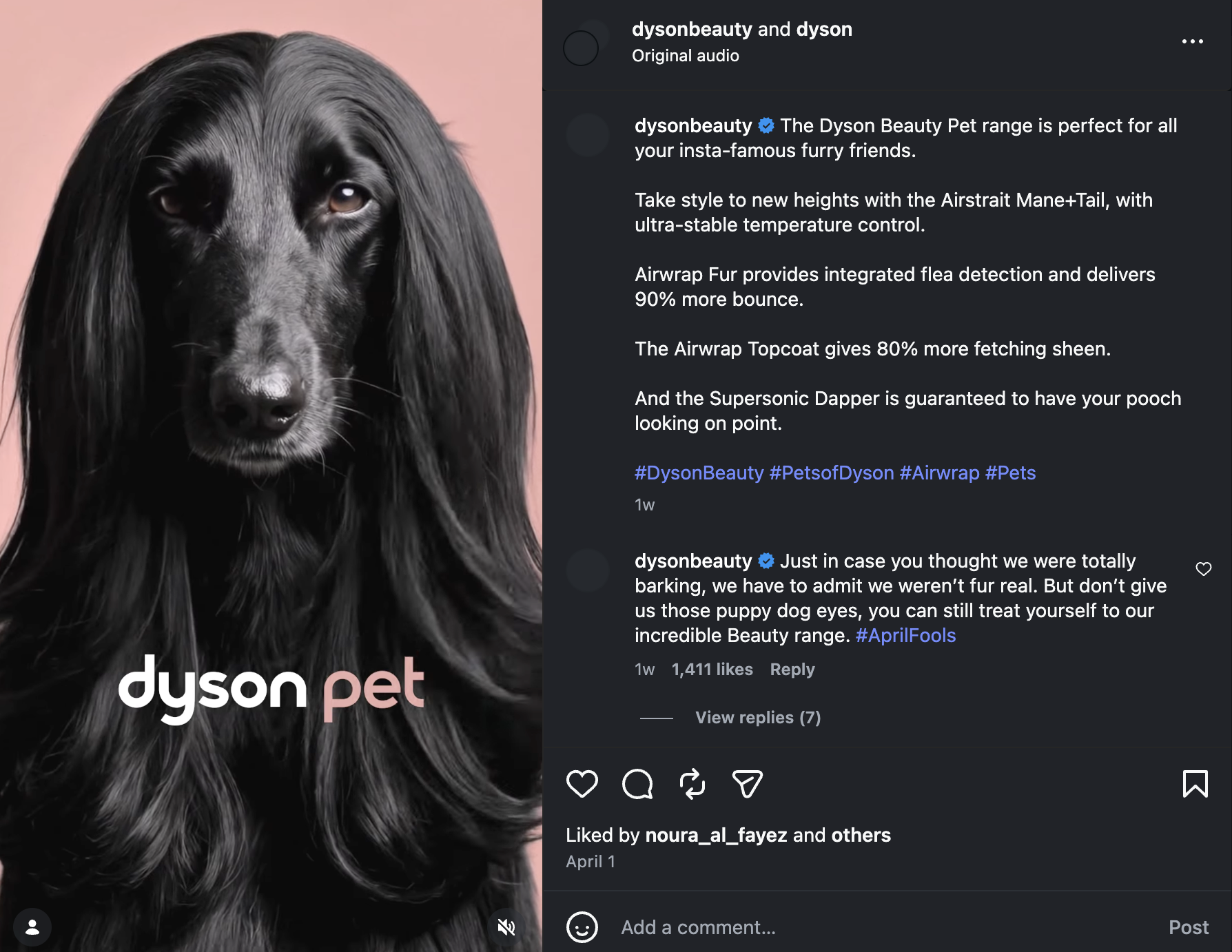
Source: Dyson
Dyson launched a fake pet styling range, an Airwrap for cats, a Supersonic for poodles. It worked because Dyson's actual product line is already so precise and category-specific that a pet extension felt like a plausible R&D direction. They didn't invent a new identity. They stretched an existing one just far enough. Dyson ran a week-long teaser before April 1, letting speculation build before the reveal. Pet influencers picked it up organically without any paid sponsorship, extending reach into PetTok at zero additional cost. The concept was built for UGC from the start, which is why amplification followed without orchestration. The question every brand should be asking before any cultural moment: if we ran a joke tomorrow, would our audience believe it? That answer doesn't come from a content calendar. It comes from knowing what your brand actually owns. At SOA, brand strategy work starts there, not with what to post, but with what's true enough about the brand that it can be stretched.
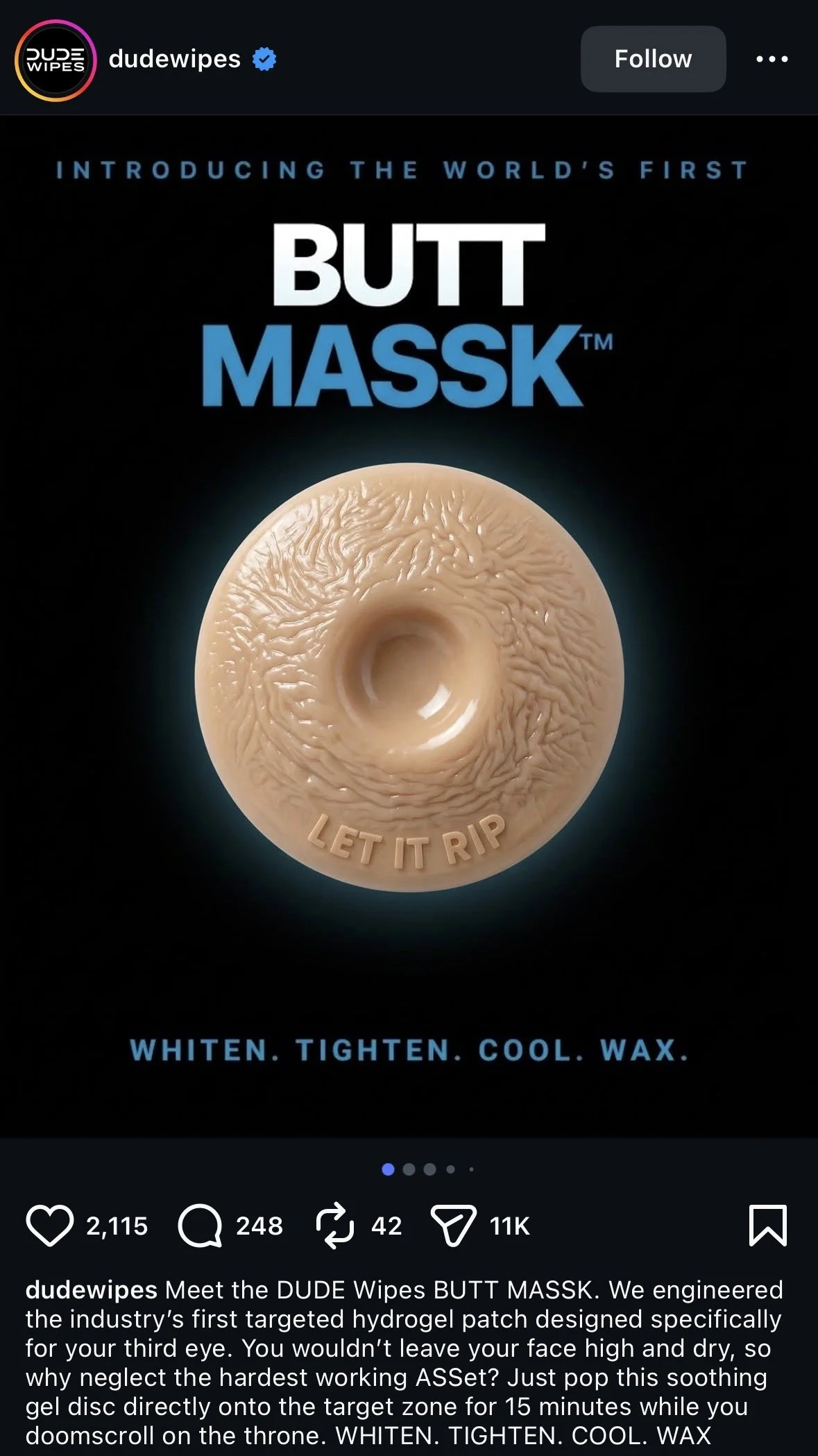
Source: DUDE
DUDE Wipes introduced the "Butt Mask", a hydrogel disc that was gross in exactly the right way for their audience. DUDE Wipes has always operated with bathroom humor as a core identity pillar, so a product like this reads as a logical extension, not a one-off stunt. The proof was in the comments: responses like "Need" and genuine purchase intent signaled that the brand understands what its audience actually wants, even when the audience has never asked for it out loud. That is what separates brand behavior exaggeration from just being gross on purpose.
The same principle played out in last year's breakdown. Owala celebrated its collectors. Supergoop leaned into "men who use one product for everything." Laneige built a fake kitchen appliance that matched the exact aesthetic its audience already lived in. None of these brands invented a new persona. They found the most exaggerated version of something they already were.
Collabs work when the logic is cultural, not just mathematical
The fake collab format dominated 2025 and continued into 2026. The assumption driving most of them: combine two audiences, and the reach multiplies. But the campaigns that actually resonated weren't built on audience math. They were built on shared cultural meaning.
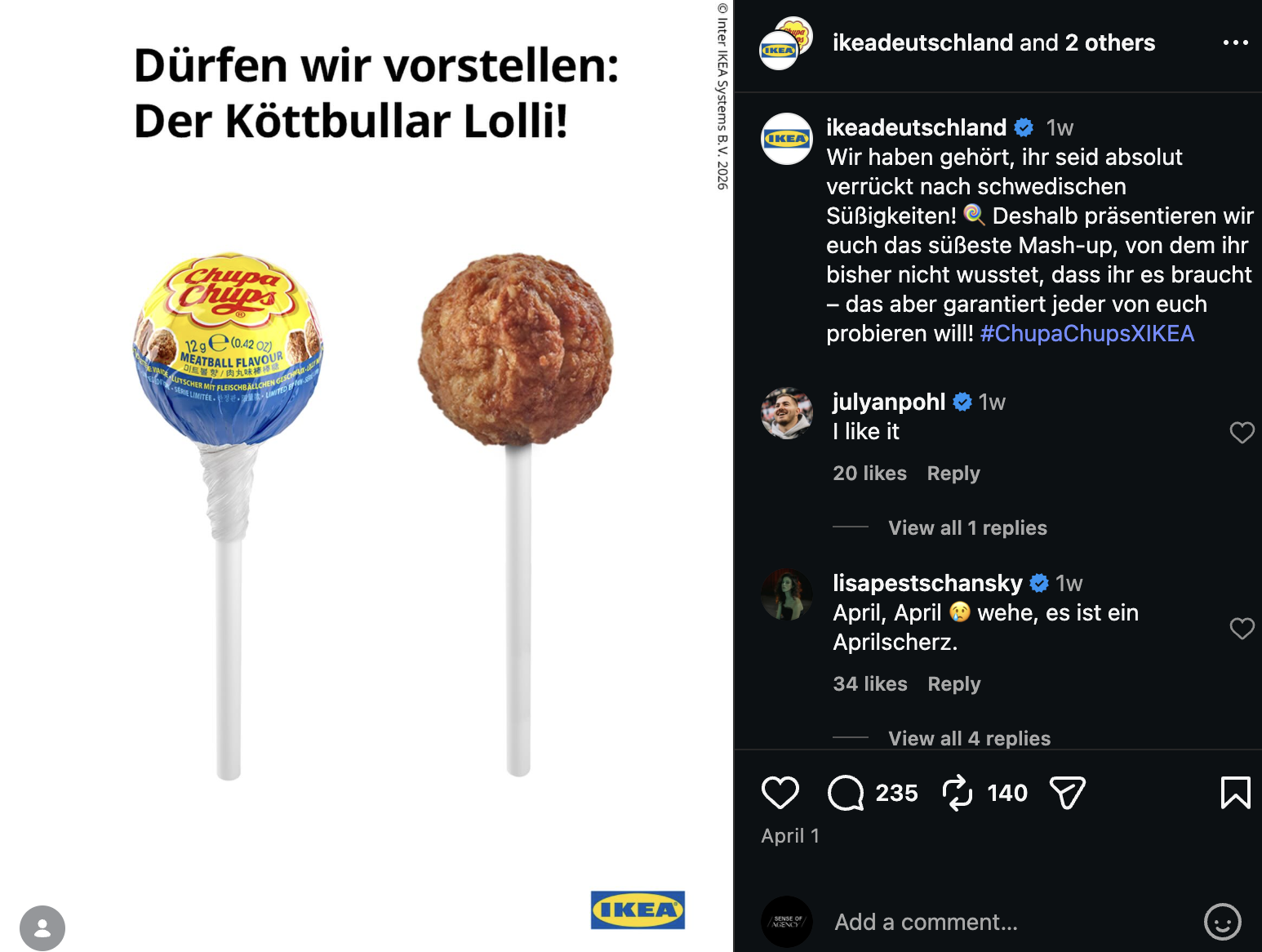
Source: IKEA x Chupa Chups
IKEA x Chupa Chups worked because IKEA's meatballs have already become a cultural artifact in their own right, detached from furniture entirely. Turning them into a lollipop borrowed that recognizability and repackaged it in a shareable format. Monty Bojangles x Babybel went a step further, anchoring the concept in the "chocuterie" trend and staging an 18-month R&D narrative complete with "peel engineers." That specificity earned believability. A joke that sounds like it took 18 months to make is harder to dismiss than one that sounds like it took 18 minutes.
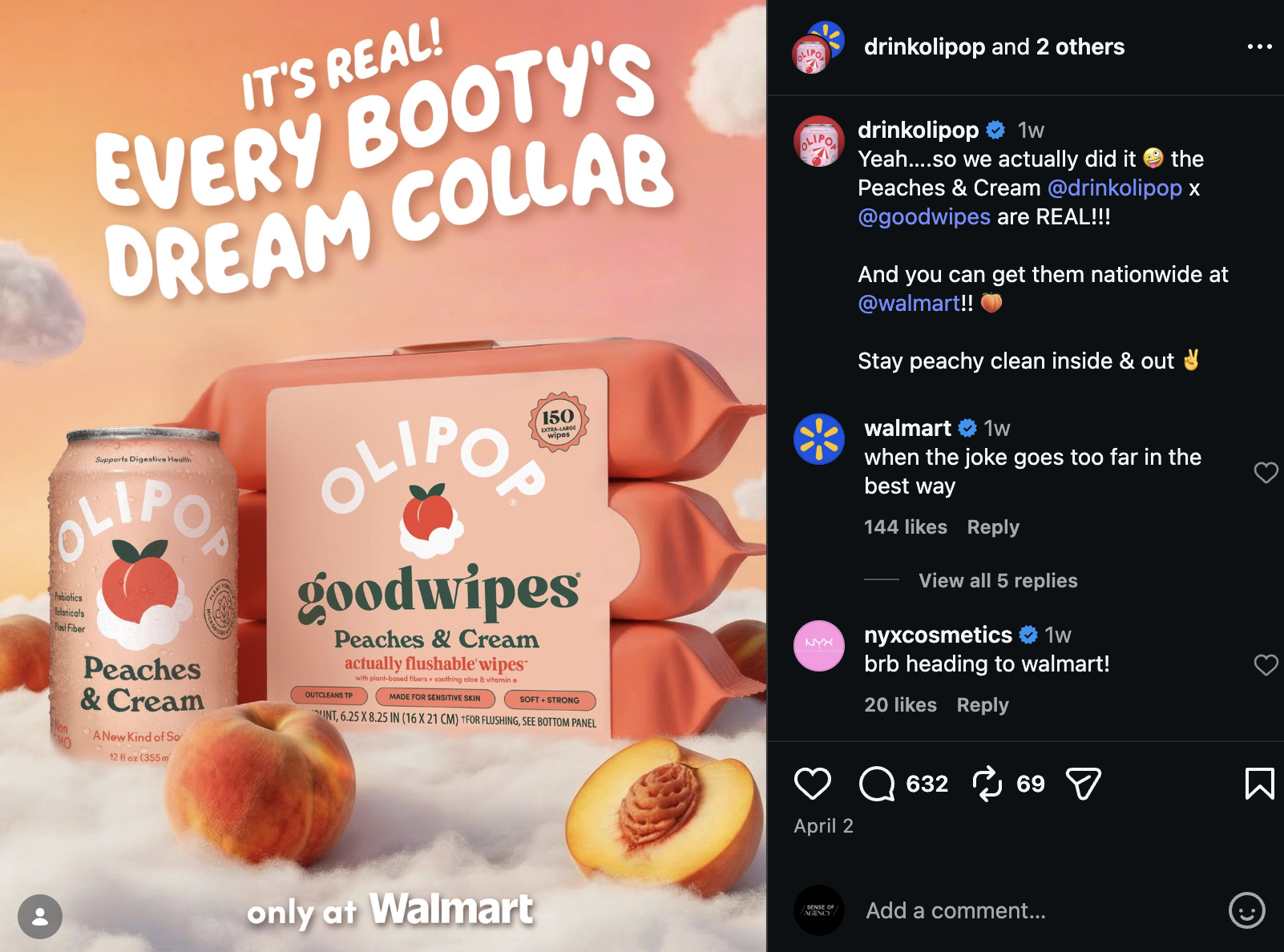
Source: OLIPOP x goodwipes
OLIPOP x goodwipes ran a double prank that most brands don't have the patience to pull off. They launched Peaches & Cream flushable wipes on April 1st with the #aprilfools tag, which technically made it a joke. But the comments told a different story: people genuinely wanted the product. That response became the setup for the real reveal. The collaboration was real all along, rolling out to 4,000 Walmart locations nationwide. The April Fools' label didn't just lower expectations. It functioned as a live market test, and the audience's reaction was the proof point the brand needed to make the announcement land. The collab also came with a clear mission: promoting digestive health and destigmatizing bathroom hygiene, which gave the whole campaign a reason to exist beyond the prank.
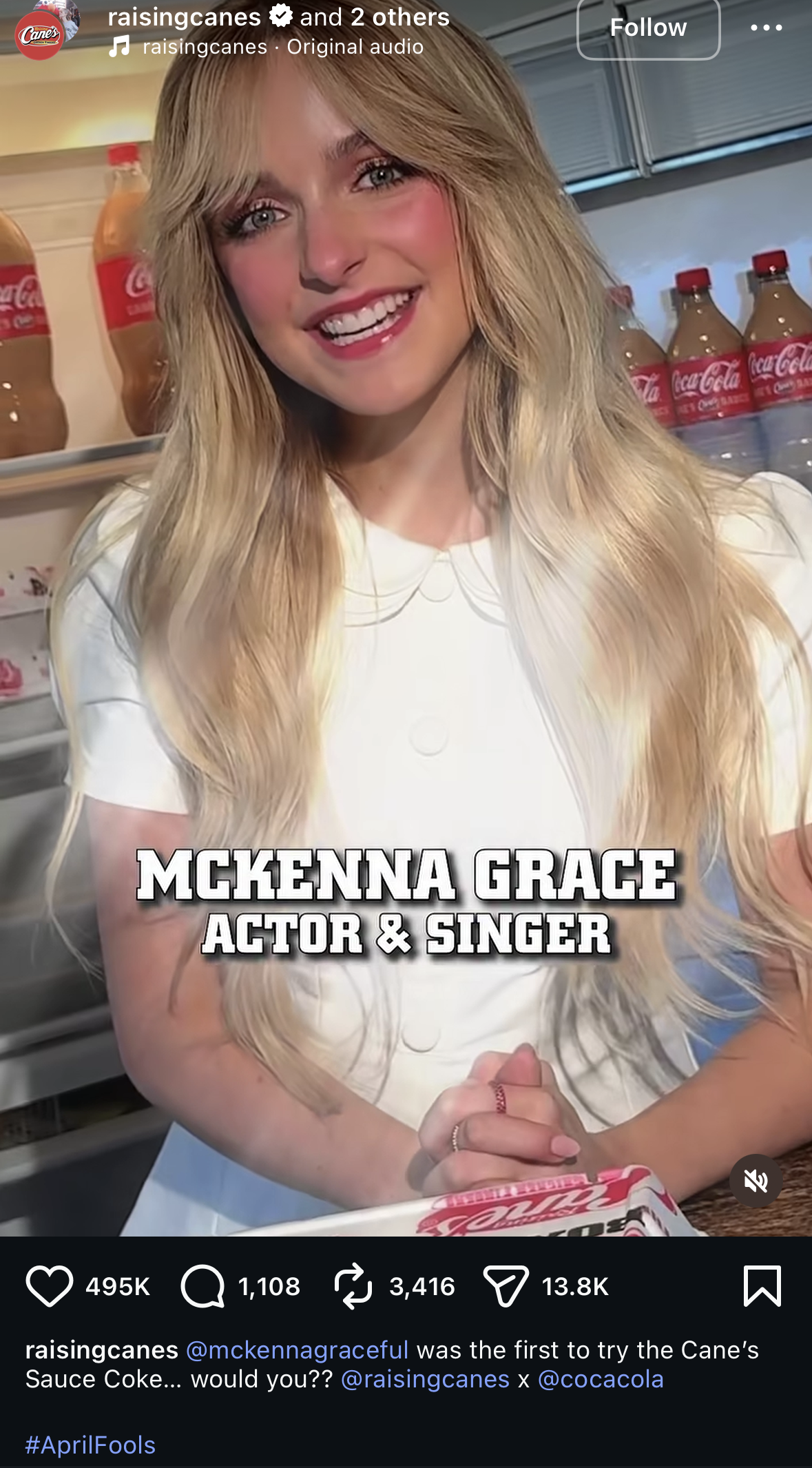
Source: Raising Cane's x Coca-Cola
By contrast, Raising Cane's x Coca-Cola had high production value and celebrity talent, but the comment section told the real story: Coca-Cola's own account, McKenna Grace, and Meta for Business were talking to each other. Brand accounts and paid talent creating engagement for each other is not cultural resonance. There was no consumer thread connecting Cane's sauce to Coca-Cola beyond the fact that both have cult followings. Assembling two audiences is not the same as finding shared meaning between them.
The gap between those two outcomes is the gap between media buying logic and brand building logic. The former asks: whose audiences overlap? The latter asks: what do we mean to people, and does that meaning connect? At SOA, when we work on brand positioning, that second question is always the starting point. An audience can be assembled. Cultural meaning has to be earned.
The format itself is part of the strategy
The furthest-thinking campaigns in 2026 didn't just have good ideas. They embedded strategy inside the execution format itself.
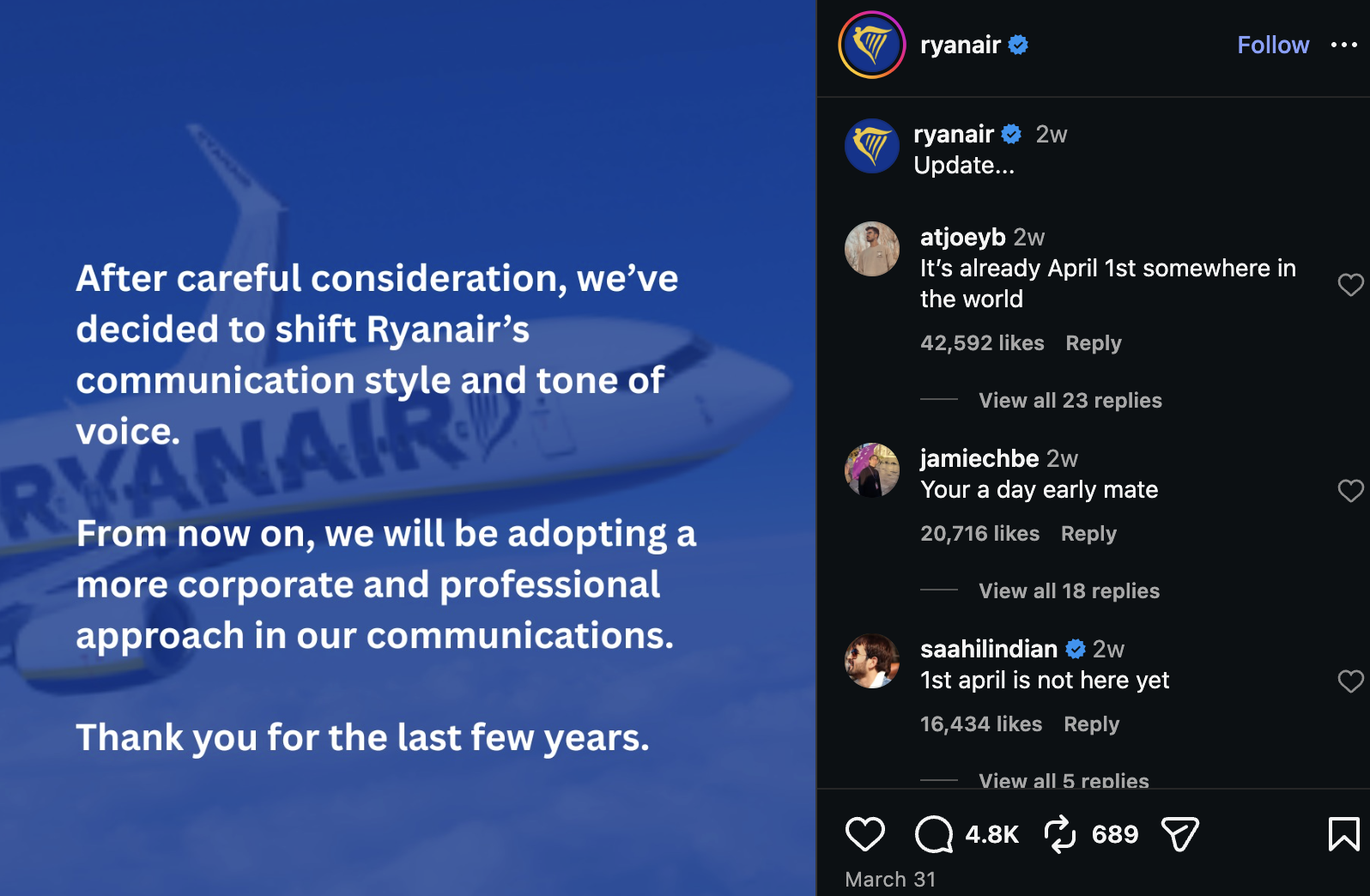
Source: Ryanair's
Ryanair's April Fools' campaign worked because it had been earning the right to make that joke all year. The airline spent early 2026 warning passengers not to wear jeans for health reasons and launching a promotional sale explicitly branded for Elon Musk and 'other idiots on X'. By the time March 31st arrived, the audience already knew exactly what kind of brand they were dealing with. That night, before April Fools' radar was fully activated, Ryanair announced it was permanently shifting to a "corporate and professional" communication style. For a brand whose entire identity is built on chaos and confrontation, the reversal was credible enough to fool thousands of people into thinking something had actually changed. The timing was deliberate: by moving on the 31st, Ryanair stepped ahead of the noise and gave marketing analysts and aviation influencers something genuine to react to before everyone else was already in on the joke.
The follow up confirmed the strategy. Rather than just letting the prank expire, Ryanair tagged its continued trolling with #ryanFOOL, turning the reveal itself into a brand moment. The joke didn't end on April 1st. It extended the bit.
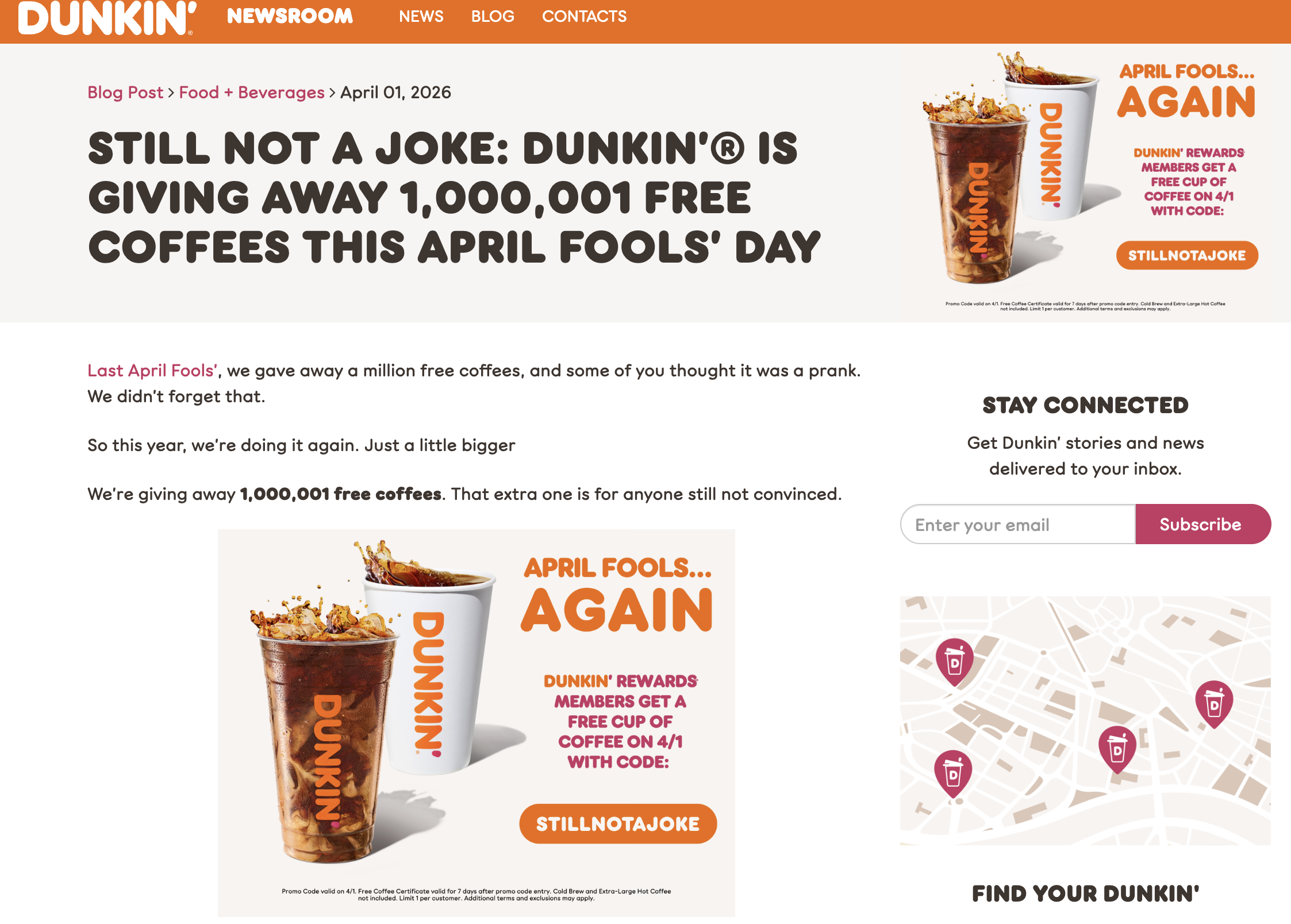
Source: DUNKIN’
DUNKIN' didn't need a fake product. Instead of building a prank, they built on one. Last April Fools' Day, they gave away a million free coffees, and some people still thought it was a joke. So in 2026, DUNKIN’ did it again, this time giving away 1,000,001. The extra one, as they put it, was for anyone still not convinced. The promo code was "StillNotAJoke." The offer was real, redeemable through the DUNKIN' app for Rewards members on April 1st. By requiring app redemption, the campaign rewarded existing members rather than chasing new ones, turning a giveaway into an engagement play. And because the offer was genuine, creators and followers had something real to share, which drove organic reach without any additional spend.
What this means for your brand
April Fools' Day used to be a test of creativity. In 2026, it became a test of strategy. The brands that stood out weren't the ones with the most elaborate pranks. They were the ones who figured out how to make the format do real work: building audiences, acquiring users, testing products, and extending campaigns beyond a single day. Two years of watching these campaigns has produced one consistent finding. The brands that win already know their audience well enough to know what would feel true. April Fools' Day didn't create that knowledge. It just put it on display.
That's the work that happens before the campaign brief opens. Knowing what your brand already owns. Knowing what your audience already believes. Knowing which format will make the strategy land, not just the joke.
That's what we do at SOA
We work with growth-stage brands that are ready to stop borrowing cultural moments and start owning them. Whether it's finding the exaggerated truth inside your brand identity, building collabs with real cultural logic, or designing campaigns that work as business moves, we help brands show up in ways their audience actually recognizes.
If you're thinking about what that could look like for your brand, we'd love to talk.
